Welcome to My World
SOPHIE (V.O., THROUGHOUT)
(Various words picked out from the diary, finishing with
“And I just feel so alone”.)
INT. BEDROOM – LATE EVENING
Sophie walks into her bedroom and sits at the desk. She opens the diary, which has the title “Welcome to MY World” on the cover, and flicks through several pages, which contain the credits and the first page of writing.
INT. BATHROOM – EARLY EVENING
Sophie is sitting on the closed lid of the toilet, holding an open pair of scissors to her arm, preparing to cut herself. She hesitates, then closes the scissors, putting them down on the edge of the sink.
INT. BEDROOM – LATE EVENING
Sophie turns the page of her diary and picks up the scissors on her desk with her left hand, looks at them, and puts them back again.
INT. DINING ROOM – EARLY EVENING
Sophie is sitting at the table at dinner with her parents. She is not eating; instead pushing the food around on her plate.
FATHER
Sophie, eat your dinner.
SOPHIE
I'm not hungry.
FATHER
I don't care if you're hungry or not, eat it!
MOTHER
Just eat it, sweetheart.
SOPHIE
I'm not hungry!
Sophie gets up to leave.
FATHER
Sit down and eat it.
Sophie runs out of the room.
INT. BEDROOM – LATE EVENING
Sophie looks down at her right hand, wrapped in a bandage. She pulls down her sleeve to cover it, and turns another page of her diary.
INT. BATHROOM – EARLY EVENING
Sophie slits her right wrist.
INT. BEDROOM – LATE EVENING
Sophie's tears fall on the diary and smudge the ink.
EXT. SCHOOL PLAYGROUND – LUNCH
Sophie is leaning against a wall, standing with a group of friends, who are talking amongst themselves. None of them speaks to Sophie.
EXT. SCHOOL PLAYGROUND – EARLY AFTERNOON
Sophie is still where she was earlier, but the playground is now empty. Sophie pushes herself up and walks across the empty playground to the gates.
INT. BEDROOM – LATE EVENING
Sophie gets up and walks to her bed, lifts a sheet and takes a bottle of alcohol. There are several other bottles, full and empty, under the bed. Sophie walks back to the desk, opens the bottle, and drinks. She turns another page of the diary.
INT. BEDROOM – NIGHT (ALT #1)
Sophie is lying on her bed, face down, screaming into her pillow.
INT. BEDROOM – NIGHT (ALT #2)
Sophie is lying face down on her bed, crying.
INT. BEDROOM – LATE EVENING
Sophie turns another page of the diary, and removes a plaster from her arm. Blood drips onto the diary. She puts the plaster back on.
INT. BEDROOM – NIGHT
Sophie's father is standing in the doorway to her bedroom. Sophie is sat on the bed, duvet pulled around her, looking scared.
INT. BEDROOM – LATE EVENING
Sophie closes the diary, turns off the light, and gets into bed. She lies awake, staring at the ceiling.
Start of film
Wednesday, 10 March 2010

Thursday, 4 March 2010
Mise-en-sceney...basic ideas...
The Mise-en-scene
Characters
Sophie = She is a 14 year old girl suffering with major depression. She is also a victim of domestic violence. She self-harms to release the pain she is feeling. She is down and dejected the majority of the time, doesn’t enjoy life, cries often and gets angry easily.
Actors
I will be acting in it as the central character Sophie. We will also require two adults to play her parents.
Costumes
Sophie = jeans, long sleeves tops, little/or no make-up. The long sleeves top is because she wants to hide her scars, she doesn't care much about her appearance due to her depression so no make up a simple clothes. However we want to portray as a normal girl, so the clothes are going to be those that could be worn by a 14 year old.
Props
We will be using some equipment as props in our films opening sequence. We will need the following items:
Scissors = these are will be used to when we show a shot of the character Sophie cutting herself.
Diary = Sophie will be seen writing her thoughts down in a diary.
Cutlery and food = Sophie will be shown with her parents not being able to eat her food.
Music
We have been discussing music we will want playing for some parts of our opening film sequence. We came up with numerous song possibilities including ‘Concrete Angel’, ‘Low’, ‘Be my escape’.
However, as I can play the piano, we will probably record our own score for the film sequence.
Characters
Sophie = She is a 14 year old girl suffering with major depression. She is also a victim of domestic violence. She self-harms to release the pain she is feeling. She is down and dejected the majority of the time, doesn’t enjoy life, cries often and gets angry easily.
Actors
I will be acting in it as the central character Sophie. We will also require two adults to play her parents.
Costumes
Sophie = jeans, long sleeves tops, little/or no make-up. The long sleeves top is because she wants to hide her scars, she doesn't care much about her appearance due to her depression so no make up a simple clothes. However we want to portray as a normal girl, so the clothes are going to be those that could be worn by a 14 year old.
Props
We will be using some equipment as props in our films opening sequence. We will need the following items:
Scissors = these are will be used to when we show a shot of the character Sophie cutting herself.
Diary = Sophie will be seen writing her thoughts down in a diary.
Cutlery and food = Sophie will be shown with her parents not being able to eat her food.
Music
We have been discussing music we will want playing for some parts of our opening film sequence. We came up with numerous song possibilities including ‘Concrete Angel’, ‘Low’, ‘Be my escape’.
However, as I can play the piano, we will probably record our own score for the film sequence.
Wednesday, 3 March 2010
The real deal has begun!!!!

We have started the work for our opening sequence. The title of our film is going to be called 'Welcome to my world.'
We came up with a few ideas for the title diary design, the above picture is the one we decided to use...the rest, below, are so design ideas we came up with but didn't use in the end. We chose the first design because it was simple and we didn't think the character would have fancy writing.


Sunday, 28 February 2010
Genres

The genre of our film is going to be a melodrama.
Melodrama
Melodrama
" Melodramatic Films are a sub-type of drama films, characterized by a plot to appeal to the heightened emotions of the audience. Melodrama, a combination of drama and melos (music), literally means "play with music." The themes of dramas, the oldest literary and stage art form, were exaggerated within melodramas, and the liberal use of music often enhanced their emotional plots. Often, film studies criticism used the term 'melodrama' pejoratively to connote an unrealistic, pathos-filled, campy tale of romance or domestic situations with stereotypical characters (often including a central female character) that would directly appeal to feminine audiences. "
Found at: http://www.filmsite.org/melodramafilms.html
Genre Conventions of a Melodrama.
Found at: http://www.lundwood.u-net.com/dissy/melo.htm·
" Music – characters in a melodrama often have trouble expressing their feelings directly, so music is used to enhance their emotions for the benefit of the audience.· Social Pressures and the inability to act – Often, in a melodrama, the main character is under pressure within society – to behave in a certain way, to achieve certain things, etc. This is connected to the way in which the protagonist is unable to act on their situation and consequently escape it. Because of the limits of the conflicts within a melodrama, the catharsis, rather than a confrontation between several characters, becomes a sort of violence turned by the protagonist against herself as the result of an inner conflict, and the masochism is demonstrated by a dependency on alcohol and other forms of release.· Characterisations and stereotypes – Characters within the melodrama are generally very “two-dimensional” and can be categorised simply into “Good and Evil, Innocence and Villainy” (Elsaesser). However, these character types are represented in a way the audience can relate to, therefore building on the characters a little more, to create some humanity. Stereotypes and situations are juxtaposed in unusual ways to encourage clashes between characters and contexts.· The privileging of the victim – melodrama considers the powerless to be on the “good” side, and those in power and control to be more “evil”. The victim is female, and the villain male.· The quick swing between emotional extremes – emotions and tensions change very quickly in a melodrama. Characters expecting a “happily ever after” are flung into more misery, a rising sense of happiness suddenly sways to once again be upsetting. "
However we did consider other genres as well. Here is a description of a few of genres we could have chosen...
- Romance
- Drama
- Action/Adventure
- Comedy
- Horror/Thriller
- Supernatural
- Crime/Detective
- Animation
- Western
- Musicals
- Rom-Com
- Film Noir
- War
- 'Chick' flicks
Thursday, 11 February 2010
Directors commentary...and don't they like to comment...
I have been listening to the Directors commentaries for several opening sequences of films...and from this I have learnt more about production of the films.
Here are some examples of comments from Directors about their films, which game me more insight into film making.
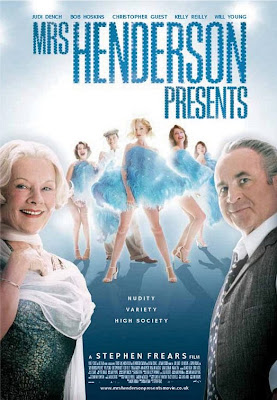
Mrs Henderson Presents
Director Stephen Frears talking. Quotes I collected from him about the opening...
"I went around for a year; asking if this was the kind of film which had an overture on it. When I was young films used to have overtures. After a year I realised the answer was yes. But of course if you have an overture, you have to have something on the screen, which I hadn’t allowed for in what I was shooting. So then we designed the sequence, and a wonderful Italian boy, a lot of young people made this sequence. Which always reminds me of March brothers films. Films made by Paramount in the 30’s."
Here are some examples of comments from Directors about their films, which game me more insight into film making.
Mrs Henderson Presents
Director Stephen Frears talking. Quotes I collected from him about the opening...
"I went around for a year; asking if this was the kind of film which had an overture on it. When I was young films used to have overtures. After a year I realised the answer was yes. But of course if you have an overture, you have to have something on the screen, which I hadn’t allowed for in what I was shooting. So then we designed the sequence, and a wonderful Italian boy, a lot of young people made this sequence. Which always reminds me of March brothers films. Films made by Paramount in the 30’s."
"The reason why I was asking the question about the overture, was that you could either say from the beginning it was the kind of musical, or of course, you could have done it as a drama which then half way through the musical bit started as a surprise."
"Oh I like this shot, it’s like, the opening of ‘Unforgiven’ a Clint Eastwood film."
"The reason it says inspired by true events was, there was always an argument about, whether the fact it was a real story was important or not. I of course in choosing to have those credits wanted the film to take place in a sort of place where musicals take place, which of course is a complete contradiction to real life."

Friday, 5 February 2010
Our preliminary video is ready!!!!!!...wooooooo!!!!!!
We have now created our preliminary piece of film, here it is:
Strength and Weaknesses from the preliminary

A mid shot
Strength and Weaknesses from the preliminary
Strengths:
- We used a variety of shots in the piece of flim. Different camera angles and shots were used. We discussed what shots we would use before filming, making it easier when it came to shooting and editing.
- We made the piece look authentic by using appropriate costumes for characters and filming it in a realistic location.
- We were able to create an interesting piece of film for the preliminary piece, which allowed us to practice skills we will need for the real piece.
Weaknesses:
- We didn't add music to the piece, this is something we can improve in our real opening sequence. Music would have helped to create a better atmosphere.
- We should have used less long shots and experimented with other types of shots.
- Using a tripod would have insured the shots weren't shaky, unfortunately at the time of filiming, the tripods weren't available.
Every member of a group had an input into the editing and we had to make a decision of what clips to use and any transactions between the clips.
Here are some screen caps from our video:
Long Shot
Long Shot
Long Shot
Low-angled close up
Close-up/Mid-shot
Close-up looking straight at the camera

A mid shot
Wednesday, 3 February 2010
180 degree rule!!
There is a rule about 'crossing the line' which is about shooting consequtive shots from alternate sides. Through watching some youtube videos such as:
 In film making terms, the 180 degree rule is extremely important in providing continuity. When filming you must ensure the characters stay on the correct side and must have the same left/right.
I was able to understand more about the rule...well considering I didn't know anything about it beforehand...that's not too hard, but that's beside the point...
 In film making terms, the 180 degree rule is extremely important in providing continuity. When filming you must ensure the characters stay on the correct side and must have the same left/right.
Another aspect of the rule is that the nearer the 180 degree axis is to the camera, the closer the audience feel to a character and the POV for the audience is the same as the characters.
Subscribe to:
Posts (Atom)


